
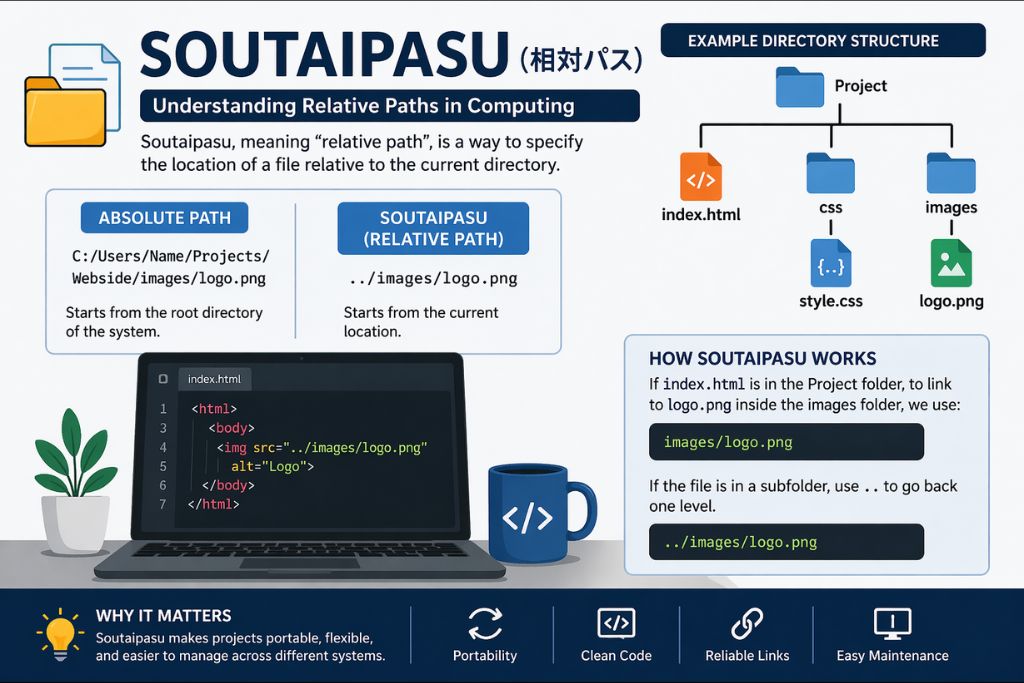
Soutaipasu, a term rooted in Japanese computing language, quietly powers a large portion of how digital systems locate and connect files. It may not appear often in casual conversations about technology, yet it remains one of the most essential concepts behind how websites, applications, and software structures function smoothly. Whenever a developer links a file without writing a full system address, soutaipasu is working in the background, shaping that connection with precision and flexibility.
Understanding soutaipasu opens a clearer view into how digital environments stay organized even when they grow complex. It represents a method of referencing files based on the current position within a directory rather than relying on an absolute system-wide address. This approach reduces complexity and increases adaptability across projects of all sizes.
The Core Meaning Behind Soutaipasu
Soutaipasu translates directly to relative path, which describes its function in the most practical sense. It defines a way of pointing to files based on where the user or program currently is located within a folder structure. Instead of mapping the entire route from the root of a system, soutaipasu builds connections using proximity and direction.
This concept becomes especially important in environments where files frequently move or where systems are designed to be portable. By relying on relative positioning, soutaipasu ensures that file references remain valid even when the main project folder is relocated. That flexibility is one of the main reasons it remains deeply embedded in programming practices.
The Logic That Powers Soutaipasu
Behind soutaipasu lies a simple yet powerful logic: context-based navigation. The system assumes a starting point, often the current working directory, and builds a path from that reference. Instead of describing where a file exists in the entire computer, it describes where the file exists relative to the present location.
This method creates a dynamic relationship between files and folders. A single project can shift across devices, servers, or environments without breaking its internal connections. Soutaipasu adapts naturally because it does not depend on fixed locations, only on relative positioning within the structure.
Why Developers Rely on Soutaipasu
Modern development practices depend heavily on structure and maintainability. Soutaipasu supports both by reducing dependency on absolute file locations. When developers write code, they often need to reference images, scripts, stylesheets, or configuration files. Using full system paths for each reference would create fragile and non-portable projects.
Soutaipasu removes that fragility. It allows a project to remain self-contained, meaning it can be moved, shared, or deployed without rewriting internal links. This is particularly valuable in collaborative environments where multiple developers work on the same system from different machines.
Soutaipasu in Web Development Environments
Web development showcases one of the most practical uses of soutaipasu. Websites are built using interconnected files, often spread across multiple folders. HTML pages need to load CSS files, JavaScript functions, and media assets. Instead of pointing to a fixed system location, soutaipasu allows these files to connect based on their relative positions within the website structure.
This means a website can be uploaded to any server without adjusting internal file links, as long as the folder structure remains consistent. That portability is essential for modern web deployment, where projects often move between local development environments and live servers.
The Difference Between Soutaipasu and Absolute Paths
Soutaipasu operates in contrast to absolute paths, which define the full location of a file starting from the root directory of a system. Absolute paths remain fixed and do not change regardless of where a project is located. While this might seem reliable, it introduces limitations when portability is required.
Soutaipasu, on the other hand, is flexible and context-aware. It does not depend on the full system structure. Instead, it builds relationships based on where the reference begins. This difference becomes critical in large-scale projects where systems must remain adaptable across environments.
The Hidden Strength of Flexibility
One of the most powerful aspects of soutaipasu is its ability to support movement without disruption. Projects built using relative paths can be transferred between systems without breaking internal links. This flexibility reduces maintenance work and allows developers to focus more on functionality rather than file management.
As software ecosystems become more complex, this adaptability becomes even more important. Applications often exist across development, testing, and production environments. Soutaipasu ensures that transitions between these environments remain smooth and predictable.
How Soutaipasu Shapes Project Architecture
Project architecture in programming depends heavily on structure. Files are arranged in folders based on functionality, purpose, or module type. Soutaipasu aligns naturally with this structure by encouraging relationships between nearby files rather than distant system locations.
This encourages cleaner organization. Instead of relying on external references, developers design systems that understand their own internal layout. As a result, projects become more modular, easier to debug, and simpler to expand over time.
Real-World Behavior of Soutaipasu
When a program uses soutaipasu, it calculates file locations dynamically at runtime or compile time, depending on the system. This means the path is not fixed in a universal sense but is interpreted based on the current environment. That interpretation allows the same codebase to behave correctly across different setups.
This behavior is especially useful in collaborative software development. Teams working in different locations can share the same project without adjusting file references for each machine. Soutaipasu handles those differences automatically through relative positioning.
The Subtle Importance in Everyday Technology
Even though soutaipasu is primarily a technical concept, its influence extends into everyday digital experiences. Websites load faster and more reliably because their internal file structures are organized using relative references. Applications remain stable across updates and deployments because their internal paths do not depend on fixed system locations.
This hidden layer of organization contributes significantly to the stability of modern digital systems. Without soutaipasu, maintaining large-scale software would require constant manual updates to file paths, increasing both complexity and error rates.
Challenges and Considerations in Using Soutaipasu
While soutaipasu offers flexibility, it also requires careful structure management. If folder organization becomes inconsistent, relative paths can break or lead to incorrect references. This makes planning an essential part of using soutaipasu effectively.
Developers must maintain a clear and logical directory structure so that relative paths remain meaningful. Without that discipline, the benefits of flexibility can turn into confusion. However, when applied correctly, soutaipasu remains one of the most efficient ways to manage file relationships.
Soutaipasu as a Foundation of Digital Design
Modern digital design relies heavily on modular thinking. Systems are built in components that interact with each other rather than existing as isolated units. Soutaipasu supports this philosophy by encouraging connections based on proximity rather than fixed addresses.
This approach aligns with scalable design principles used in large applications, cloud systems, and interactive web platforms. It allows systems to grow without becoming overly dependent on rigid file structures.
Conclusion: The Quiet Role of Soutaipasu in Technology
Soutaipasu continues to play a foundational role in how digital systems operate, even if it remains largely invisible to most users. Its ability to create flexible, portable, and maintainable file structures makes it essential in programming and web development. By focusing on relative positioning rather than absolute location, it introduces a smarter way of thinking about digital organization.
As technology continues to evolve, soutaipasu remains a silent yet powerful force behind the scenes, ensuring that systems stay connected, adaptable, and efficient across changing environments.