
Understanding the Purpose of a Proforma Invoice
Every successful business transaction begins with clear communication. Before products are shipped or services are delivered, buyers and sellers need a shared understanding of pricing, quantities, payment terms, delivery schedules, and other important conditions. A proforma invoice serves this purpose by providing a detailed preview of a transaction before it becomes official. Although it resembles a standard invoice, it is not a demand for payment or a legally recognized tax document. Instead, it acts as a formal proposal that helps both parties confirm the details of a sale before moving forward.
Businesses of all sizes rely on proforma invoices to reduce misunderstandings, improve transparency, and streamline domestic as well as international trade. Whether a company exports products overseas, manufactures custom goods, or handles large wholesale orders, issuing a proforma invoice gives customers confidence in the transaction while allowing sellers to present accurate pricing and commercial terms. Understanding how this document works is essential for business owners, accountants, exporters, importers, and anyone involved in commercial transactions.
What Is a Proforma Invoice?
A proforma invoice is a preliminary commercial document issued by a seller to a buyer before the actual sale is completed. It outlines the products or services being offered, estimated prices, payment conditions, shipping arrangements, delivery timelines, and other relevant details. Since the transaction has not yet been finalized, the figures and information contained in a proforma invoice may still change if both parties agree to modifications.
Unlike a final invoice, a proforma invoice does not record revenue in accounting books and generally cannot be used for tax reporting. Its primary purpose is to give the buyer a complete picture of the expected transaction so that approvals, financing, customs documentation, or purchase decisions can be completed before the order is confirmed.
Many businesses issue a proforma invoice after a customer accepts a quotation but before production or shipment begins. This document serves as an important bridge between an initial price estimate and the final commercial invoice.
Why Businesses Use a Proforma Invoice
A proforma invoice helps businesses create transparency during the early stages of a sale. Instead of relying on verbal agreements or informal emails, both parties receive a structured document that clearly explains every aspect of the proposed transaction. This reduces the likelihood of pricing disputes, misunderstandings about delivery dates, or confusion regarding payment methods.
International trade depends heavily on proforma invoices because importers often need them to apply for import licenses, arrange customs clearance, secure foreign exchange approvals, or obtain financing from banks. Financial institutions may also request a proforma invoice when processing letters of credit or evaluating international payment arrangements.
Even domestic businesses benefit from using proforma invoices when dealing with customized orders, bulk purchases, or projects where production begins only after customer approval. By documenting agreed terms before work starts, companies can avoid costly revisions later in the sales process.
Key Features of a Proforma Invoice
Although a proforma invoice is not a final invoice, it contains many of the same details found in official billing documents. A professionally prepared proforma invoice includes the seller’s business information, the buyer’s contact details, a unique proforma invoice number, the issue date, and a validity period that specifies how long the quoted prices remain effective.
The document also lists every product or service involved in the transaction, including descriptions, quantities, unit prices, subtotal amounts, shipping charges, estimated taxes where applicable, and the total projected value of the order. Payment terms, expected delivery schedules, shipping methods, currency information, and applicable trade terms such as Incoterms are commonly included as well.
Most proforma invoices clearly state that they are not tax invoices and should not be treated as requests for payment. This disclaimer helps distinguish the document from legally recognized commercial invoices.
Benefits of Using a Proforma Invoice
A proforma invoice offers significant advantages for both buyers and sellers. One of its greatest strengths is the ability to establish clear expectations before the transaction is finalized. Buyers know exactly what they are purchasing, how much it will cost, and when delivery is expected, while sellers gain written confirmation of the proposed agreement.
The document also simplifies communication between businesses operating in different countries. Language barriers, currency differences, shipping requirements, and customs regulations become easier to manage when all transaction details are organized in a single document.
From a financial perspective, a proforma invoice allows buyers to arrange funding or obtain internal management approval before committing to a purchase. It also enables exporters to prepare shipping documentation more efficiently, reducing delays that could otherwise affect delivery schedules.
Another major advantage is professionalism. Businesses that consistently issue detailed proforma invoices demonstrate reliability and transparency, helping build trust with new customers and long-term clients alike.
Common Situations Where a Proforma Invoice Is Used
Proforma invoices are used in many different industries because they provide flexibility before a sale becomes legally binding. Exporters frequently prepare proforma invoices before shipping goods internationally, allowing overseas buyers to satisfy customs and banking requirements. Manufacturers often use them for custom-made products that require customer approval before production begins.
Wholesale suppliers issue proforma invoices for large purchase orders so buyers can verify pricing, quantities, and shipping costs before confirming the transaction. Service providers may also prepare proforma invoices when offering complex projects that involve multiple stages of work, allowing clients to review estimated costs before signing a contract.
Businesses requesting advance payments often rely on proforma invoices because they clearly explain the expected charges while making it clear that the final invoice will be issued later. This creates a transparent payment process and reduces confusion about future billing.
Essential Components of a Professional Proforma Invoice
Creating a professional proforma invoice requires more than simply listing products and prices. Every section of the document should contribute to a clear understanding of the proposed transaction. Accurate company information, customer details, product descriptions, pricing structures, and payment instructions help eliminate ambiguity while ensuring both parties have a shared understanding of the agreement.
Including shipping information is particularly important for international transactions. Details such as transportation methods, delivery locations, estimated shipment dates, insurance arrangements, and applicable trade terms help buyers prepare for customs procedures and logistics planning. Many exporters also include Harmonized System (HS) codes and country-of-origin information to support customs documentation.
A well-designed proforma invoice reflects the professionalism of the business issuing it. Clean formatting, organized sections, consistent branding, and accurate calculations create confidence and make it easier for customers to review and approve the transaction before it proceeds.
Proforma Invoice vs Invoice
One of the most common questions among business owners and entrepreneurs is the difference between a proforma invoice and a commercial invoice. Although both documents share a similar appearance and often contain much of the same information, they serve entirely different purposes within the sales process.
A proforma invoice is issued before the sale is completed. It acts as a preliminary document that outlines the expected details of a transaction, including product descriptions, estimated prices, payment terms, shipping costs, and delivery information. Since it represents a proposed sale rather than a completed one, it does not create a legal payment obligation and is generally not recorded in a company’s accounting system.
A commercial invoice, on the other hand, is issued after the buyer confirms the order and the goods or services are ready for delivery or have already been delivered. This document serves as the official bill for the transaction and is legally recognized for accounting, taxation, and payment purposes. Businesses use commercial invoices to record revenue, calculate taxes, and request payment from customers.
Another important distinction is flexibility. A proforma invoice can be modified if the buyer requests changes to quantities, pricing, or shipping arrangements before the order is finalized. Once a commercial invoice has been issued, any corrections usually require additional documentation such as credit notes or revised invoices.
Understanding the difference between these documents helps businesses maintain accurate financial records while ensuring buyers receive clear and transparent information before committing to a purchase.
Proforma Invoice vs Quotation
Although a quotation and a proforma invoice are both used before a sale is finalized, they are not interchangeable documents. A quotation is generally the first formal response to a customer’s request for pricing. It provides an estimate of costs for products or services and may include basic terms such as validity dates and expected delivery periods. Quotations are commonly used during negotiations when buyers are comparing multiple suppliers before making a purchasing decision.
A proforma invoice is typically issued after the buyer has expressed an intention to proceed with the purchase. It contains much more detailed commercial information than a quotation and closely resembles a final invoice. Along with product descriptions and pricing, it includes payment instructions, shipping methods, currency details, packaging information, taxes where applicable, and delivery terms.
In international trade, buyers often require a proforma invoice rather than a quotation because banks, customs authorities, and government agencies may request this document when processing import permits, letters of credit, or customs declarations. A simple quotation usually does not contain enough information for these purposes.
Businesses often follow a logical sales sequence that begins with a quotation, continues with a proforma invoice after customer approval, and concludes with the issuance of a commercial invoice once the transaction is completed.
Proforma Invoice vs Tax Invoice
Another area of confusion involves the relationship between a proforma invoice and a tax invoice. Despite their similar appearance, these documents have completely different legal and accounting functions.
A proforma invoice is not considered a tax document. While it may display estimated taxes or duties for informational purposes, it does not create a tax liability for either the seller or the buyer. Because no sale has officially occurred, businesses generally cannot use a proforma invoice for bookkeeping, financial reporting, or tax filing.
A tax invoice is issued only after a taxable transaction has taken place. It contains all legally required tax information, including applicable VAT, GST, or sales tax, depending on local regulations. Buyers often need a tax invoice to claim input tax credits, while sellers use it to report taxable sales to government authorities.
For businesses operating internationally, issuing the correct document at the appropriate stage of the transaction is essential for maintaining compliance with accounting standards and tax regulations. Using a proforma invoice in place of a tax invoice could lead to reporting errors or delays in customs and financial processing.
How to Create a Professional Proforma Invoice
Preparing a professional proforma invoice requires careful attention to detail. Since the document serves as an official proposal, accuracy and clarity are essential. Every piece of information should help the buyer understand exactly what is being offered and under what conditions.
The document should begin with a clear title stating “Proforma Invoice” so there is no confusion with a commercial or tax invoice. It should then display the seller’s business name, address, contact information, and tax registration details if applicable. The buyer’s information should follow, including the company name, address, and contact details.
Each product or service should be described thoroughly, including model numbers, specifications, quantities, unit prices, and total values. Shipping charges, insurance costs, estimated taxes, discounts, and the grand total should be calculated accurately. Payment methods, delivery schedules, currency, and shipping terms such as FOB, CIF, or EXW should also be included where relevant.
A validity period is another important component. Since prices may fluctuate due to exchange rates or market conditions, businesses often specify that the proforma invoice remains valid for a certain number of days. Adding a statement indicating that the document is not a request for payment and does not constitute a tax invoice further reduces the risk of misunderstandings.
Proforma Invoice Sample
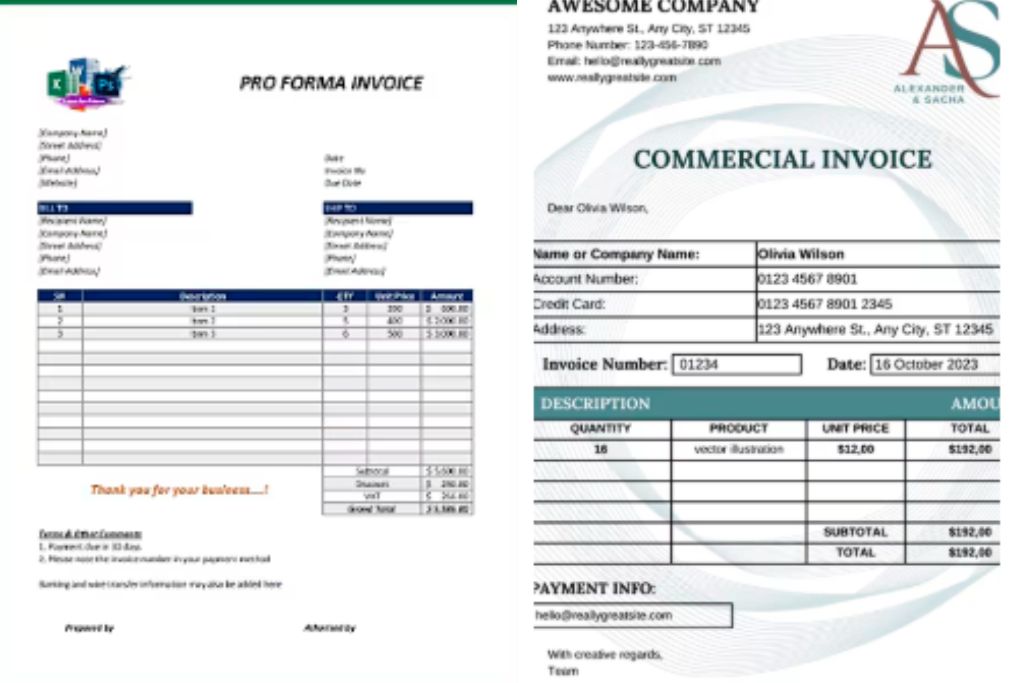
A standard proforma invoice follows a structured format that resembles a final invoice while clearly identifying itself as a preliminary document. The top section typically includes the company logo and the heading “Proforma Invoice,” followed by the invoice number and issue date. Seller and buyer information appear beneath the heading, providing complete identification for both parties.
The main section contains a table listing the products or services included in the proposed transaction. Each line includes the item description, quantity, unit price, and total amount. Beneath the table, the document summarizes the subtotal, shipping charges, insurance costs, estimated taxes, and the final estimated total.
The lower portion usually contains payment instructions, expected delivery dates, shipping methods, banking information, and any additional notes. Many businesses conclude the document with a disclaimer stating that it is issued for informational purposes only and will be replaced by a commercial invoice once the sale is finalized.
This structured format ensures buyers have all the information they need before confirming the purchase.
Proforma Invoice PDF
Many businesses choose to distribute proforma invoices in PDF format because it provides a professional appearance while preserving the document’s layout across different devices and operating systems. Unlike editable files, PDF documents reduce the risk of accidental formatting changes or unauthorized modifications after the invoice has been issued.
Sending a proforma invoice as a PDF also simplifies communication with customers, suppliers, banks, freight forwarders, and customs authorities. Since PDF files are widely accepted and easy to open, they have become the preferred format for international trade documentation.
Modern accounting software and invoicing platforms allow users to generate professional PDF proforma invoices automatically. Businesses can customize templates with company logos, branding elements, and payment instructions while maintaining consistency across all customer communications.
Proforma Invoice Short Form
The most widely accepted short form of a proforma invoice is PI. Businesses frequently use this abbreviation when assigning invoice numbers or organizing accounting records. For example, invoice numbers may appear as PI-1001, PI-2026-045, or simply PI No. 1250.
Using the abbreviation helps distinguish proforma invoices from commercial invoices, purchase orders, quotations, and tax invoices within accounting systems. Many enterprise resource planning (ERP) platforms and invoicing software automatically use the “PI” prefix when generating these documents, making record management more organized and efficient.
Proforma Invoice in Chinese
As international trade with China continues to grow, many importers and exporters regularly work with bilingual commercial documents. The Chinese translation for Proforma Invoice is 形式发票, which is pronounced Xíngshì Fāpiào. This term is widely recognized by Chinese manufacturers, exporters, customs brokers, and logistics companies.
Chinese suppliers frequently issue proforma invoices in both English and Simplified Chinese to ensure that buyers from different countries can clearly understand the transaction details. A bilingual document minimizes language barriers while helping customs authorities, freight forwarders, and financial institutions verify shipment information accurately.
A Chinese proforma invoice usually contains the same information found in English versions, including the seller’s and buyer’s details, product descriptions, quantities, unit prices, total value, payment terms, shipping methods, country of origin, packing details, and estimated delivery dates. Providing both languages on the same document helps reduce misunderstandings and speeds up international business transactions.
Proforma Invoice Spelling
One question that often appears in online searches is whether the correct spelling is Proforma Invoice or Pro Forma Invoice. The good news is that both versions are considered correct and are widely accepted in international business.
The single-word form, Proforma Invoice, is commonly used in the United Kingdom, Europe, and many international trade documents. Accounting software, ERP systems, and export documentation frequently adopt this spelling because it is concise and easy to recognize.
The two-word version, Pro Forma Invoice, is more commonly seen in North America and in some accounting publications. Despite the slight variation in spelling, both terms describe the exact same document and carry the same commercial meaning.
For SEO purposes, including both spellings naturally within your content can help capture search traffic from users in different regions without affecting readability.
Best Practices for Creating a Proforma Invoice
A professionally prepared proforma invoice reflects the credibility and reliability of a business. While the document is not legally binding as a final invoice, it should still be treated with the same level of care and accuracy.
Businesses should always use a unique proforma invoice number to simplify document tracking and future reference. Every product or service should be described clearly, including accurate quantities, specifications, pricing, and applicable discounts. Shipping charges, estimated taxes, insurance costs, and payment terms should be presented transparently so buyers understand the complete financial picture before approving the transaction.
Including a validity period is equally important. Market prices, currency exchange rates, and transportation costs can change quickly, particularly in international trade. A clearly stated expiration date protects sellers from honoring outdated pricing while encouraging buyers to make timely purchasing decisions.
Another best practice is to include shipping terms such as Incoterms whenever goods are being transported internationally. These internationally recognized trade rules define the responsibilities of buyers and sellers regarding transportation, insurance, customs clearance, and delivery, reducing the likelihood of future disputes.
Finally, every proforma invoice should contain a clear statement explaining that the document is provided for informational purposes only and does not constitute a tax invoice or final request for payment. This simple disclaimer helps distinguish it from legally binding commercial invoices.
Common Mistakes to Avoid
Although preparing a proforma invoice is relatively straightforward, several common mistakes can create confusion or delay business transactions. One of the most frequent errors is treating a proforma invoice as though it were a commercial or tax invoice. Since it is only a preliminary document, businesses should never record it as revenue or use it for official tax reporting.
Another mistake involves incomplete or inaccurate product descriptions. Missing specifications, incorrect quantities, or pricing errors can lead to misunderstandings between buyers and sellers, potentially delaying production or shipment. Businesses should carefully review every detail before sending the document to customers.
Some companies also forget to specify payment terms or shipping conditions. Without this information, buyers may be uncertain about deposit requirements, payment deadlines, or delivery responsibilities. Including these details from the beginning creates transparency and reduces the risk of disputes.
Failing to include an expiration date is another common oversight. Without a validity period, customers may attempt to place orders months later using outdated prices, creating unnecessary negotiations or financial losses for the seller.
Lastly, businesses should avoid sending editable documents unless requested. Providing proforma invoices in PDF format helps preserve formatting and ensures the document remains professional and secure.
Frequently Asked Questions
Many businesses wonder whether a proforma invoice can be used to request payment. While it may outline the expected amount due, it is generally considered a preliminary document rather than an official demand for payment. Once the sale is confirmed, a commercial or tax invoice should be issued according to applicable business and legal requirements.
Another common question concerns accounting. Since a proforma invoice does not represent a completed sale, it is generally not entered into accounting records as revenue or accounts receivable. Financial transactions are recorded only after the final invoice has been issued and the sale has officially taken place.
Business owners also ask whether proforma invoices are mandatory. The answer depends on the nature of the transaction. Domestic sales may not always require one, but international trade often relies on proforma invoices for customs documentation, banking procedures, import licenses, and buyer approvals.
Many exporters wonder whether prices shown on a proforma invoice can change. In most cases, yes. Because the document is only a proposal, prices may be adjusted before the final invoice is issued if exchange rates, shipping costs, product specifications, or customer requirements change. Any modifications should be communicated clearly and approved by both parties.
Conclusion
A proforma invoice is much more than a preliminary pricing document. It serves as an essential communication tool that allows buyers and sellers to agree on every aspect of a transaction before goods are produced, shipped, or delivered. By outlining product details, pricing, payment terms, shipping arrangements, and commercial conditions in advance, it helps prevent misunderstandings and creates a smoother purchasing process.
Understanding the differences between a proforma invoice vs invoice, proforma invoice vs quotation, and proforma invoice vs tax invoice enables businesses to use each document correctly at the appropriate stage of a transaction. Whether you are preparing a proforma invoice sample, generating a proforma invoice PDF, using the PI short form, working with suppliers who issue a proforma invoice in Chinese, or simply verifying the correct proforma invoice spelling, mastering this document is an important step toward professional and efficient business operations.
As global trade continues to expand and digital invoicing becomes increasingly common, businesses that create accurate, transparent, and well-structured proforma invoices will strengthen customer trust, simplify international transactions, and build stronger long-term commercial relationships. A carefully prepared proforma invoice not only supports smooth negotiations but also lays the foundation for successful business partnerships in today’s competitive marketplace.